Motherhood Under the Problem
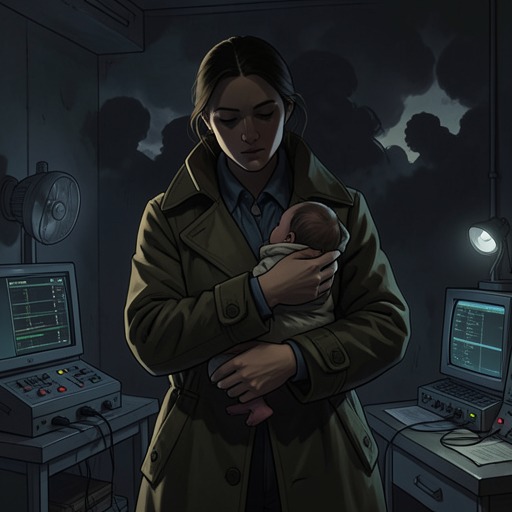
Bird BoxMotherhood Under the Problem is the work of keeping children alive when ordinary care has become inseparable from fear. Through Malorie, the novel makes motherhood a daily practice of protection, training, and bodily endurance, but also a source of moral uncertainty: survival may require the very restrictions that make a child’s life feel diminished. The children are safe because Malorie teaches them to obey, yet that safety leaves her asking what kind of future she is protecting for them.
Protection and the Question of a Future
Four years into life behind blindfolds, Malorie imagines how easily the years could multiply: four becoming eight, then twelve, until the children are adults who have never seen the sky or looked through a window. She fears that the clouds might become unreal to them, and that they might feel at home only behind the black cloth. The image turns protection into a potentially permanent enclosure: the children can survive without knowing what they have lost, but Malorie cannot stop measuring their lives against the open world they are forbidden to see.
That fear becomes an accusation directed inward. Malorie wonders whether she could protect them for another ten years, whether she would eventually have to depend on them to guard her, and what sort of life such vigilance would preserve. She judges herself a bad mother for not finding a way to let them run through the yard, street, and neighborhood of empty homes, or to offer even one glimpse of a star-filled sky. The questions do not resolve into a rejection of motherhood; they expose the cost of a form of care in which keeping children alive may also mean withholding experiences that ordinarily make childhood expansive.
Training, Obedience, and Fear
The children’s discipline is not simply a natural consequence of growing up in danger. Malorie deliberately trains them to wake with their eyes closed. When either baby opens their eyes, she strikes the child’s arm with a flyswatter; when the child keeps their eyes shut, she closes their eyes with her fingers and rewards obedience by lifting her shirt to feed them. In this starkly conditioned routine, nourishment and protection are bound to the same lesson. Malorie’s care is tender in its purpose, but its method teaches through pain, fear, and reward.
Years later, the children’s refusal to remove their blindfolds when they hear an unfamiliar man’s voice on the river demonstrates that the training has worked. Malorie recognizes the achievement and recoils from what it means: she has made them so afraid that they will not disobey her under any circumstances. She remembers her own childhood acts of rebellion—sneaking sugar, watching forbidden films, and moving her bed into the living room—and understands that her children have none of those ordinary opportunities to test boundaries. Their obedience is a survival skill, but it is also evidence of how much childhood has been narrowed.
Motherhood therefore operates through surveillance as well as instruction. Malorie checks blankets, cribs, and the children’s eyes, knowing that exposure outside could be fatal. Care means preventing a dangerous look before it occurs, while teaching the children to regulate themselves even when she cannot intervene. Their compliance protects them from immediate danger; it also makes fear a force they carry within themselves. The novel sets this trained vigilance against the unsupervised disobedience Malorie recalls from her own youth, marking the distance between childhood in the old world and childhood under the Problem.
Bodily Labor and the Limits of Care
The novel locates maternal responsibility in practical work as well as emotional conflict. Before giving birth, Malorie repeatedly imagines the absence of a doctor, medicine, friends, and family. She tries to picture labor as a quick event that will end with the baby in her arms, but avoids imagining what will happen in between. The gap in that fantasy registers the limits of what she can prepare for: the duty to deliver and protect a child remains, while the support once associated with birth is unavailable.
The care structure around the house makes such work visible in small, specific acts. At the well, Cheryl waits inside the closed back door as a safety net while Felix draws water; the arrangement depends on someone remaining alert to danger even when no emergency occurs. Later, when panic threatens to immobilize the household, Malorie assigns chores: dinner, the waste bucket, the cellar, a search of the yard for tools, feeding the birds, phone calls, and clean bedding. She insists that the little things, including sheets washed only a week earlier, make life in the house bearable. Her intervention turns care into collective maintenance rather than a private maternal feeling, and the housemates respond by taking up the work.
The contrast between the small household tasks and the larger threat is deliberate. Food, water, cleanliness, and readiness do not defeat the danger, but they sustain people in its presence. Malorie’s own maternal labor takes place within this broader network of survival work, even as her children’s dependence makes her responsible for risks the other housemates do not bear in the same way.
The Moral Burden of What Protection Might Require
Don’s proposal that newborns be blinded forces Malorie to confront the most extreme possibility raised by protective care. Olympia regards the idea as insane and cruel, but Malorie understands its logic because her motherhood is already organized around guarding a child’s eyes. She does not experience the suggestion chiefly as an abstract moral puzzle; she wonders whether she would be physically capable of doing it. The distinction matters: recognizing the proposal as a possible means of protection does not make the act easy or erase its violence.
In the dark, listening to the babies breathe, Malorie concludes that Don’s suggestion is not a bad one. She thinks of the blankets and cribs she checks, the danger the babies cannot yet remember, and the possibility that they would not feel robbed of sight if they had never possessed it. The reasoning is severe and conditional: in a world where looking can destroy a person, blindness might remove a danger before a child has to fear it. Yet the thought remains harrowing, a measure of how radically the Problem has changed the terms of maternal responsibility. Protection can begin to resemble deprivation, and a decision made for a child’s safety may foreclose a choice the child cannot yet make.
Isolation, Shame, and a Possible New World
Malorie’s uncertainty is intensified by the absence of Tom. When he was alive, she could imagine that he would call her the best mother on Earth and that she would believe him. Without him, she has only herself to consult. Alone at the kitchen table while the children sleep, she returns to the question of whether a good mother still exists. The imagined reassurance and the actual solitude remain sharply divided: confidence is available to her as Tom’s imagined judgment, not as a certainty she can supply for herself.
On the river, the children’s continued obedience brings both relief and shame. Malorie is exhausted from rowing, with burning arms and cold water in the bottom of the boat, while the Girl’s urine mingles with the water near her shoes. She has trained the children well enough that they did not remove their blindfolds when they encountered a stranger—the first living human voice they had heard apart from each other—yet she cannot regard that success simply as a victory. The scene makes the material strain of care inseparable from its psychological cost: she must keep moving, keep listening, and carry the knowledge that the habits saving the children were made through fear.
Even so, the river journey holds open a different possibility. Malorie hears the Boy breathing ahead of her and the Girl handling puzzle pieces behind her; they are protected beneath their blindfolds, but the journey might take them to a world in which they could see things they have never seen. That possibility does not erase the years of enclosure or guarantee an uncomplicated release. It gives Malorie’s labor a destination beyond survival alone: she is trying to preserve the children long enough for another kind of life to become possible.
The ending keeps the physical cost of that responsibility in view. After the birth, Malorie secures the house again and expects to search it inch by inch with a broomstick before she can feel safe enough to open her eyes. Six hours will pass before she sees what happened while she was delivering her baby. With her eyes still tightly closed, she steps back through the living room toward the cellar stairs and passes Tom’s body. Motherhood here offers no clean division between birth and catastrophe, or between protecting the living and moving through the presence of the dead. Its significance lies in that unbroken burden: Malorie continues to act for the children amid exhaustion and grief, without the promise that care will ever feel like certainty.